People have been setting dates for the return of Jesus for two thousand years, and the scoreboard reads: predictions, thousands; correct, very few at best.
I get why. When you feel the urgency of the times, "no man knows the day nor the hour" starts to sound like a cop-out. But here's what I've come to believe after years of laying these scriptures side by side: scripture never gives us a calendar. It gives us a sequence. An order of operations. What has to happen before what.
And when you actually follow that sequence — Matthew 24, D&C 45, Moses 7, Ether 13, Revelation — you arrive somewhere most people aren't prepared for. Not that the return of Christ is coming soon. That in a very real and scriptural sense, it has already begun. Just not the way most of us were taught to watch for it.
I know how that sounds. Stay with me.
The Sequence Scripture Actually Gives Us
At a big macro level, the timeline scripture lays out looks like this: the gathering and the sweep of truth across the earth, then the sign and return of the Son of Man, then the binding of the dragon, then the thousand years of peace, and finally the celestial New Jerusalem descending at the end of it all.
Five phases. Each one anchored in specific scripture. And the key to reading them correctly — the thing that unscrambles the whole board — is realizing that scripture describes not one New Jerusalem, but two.
Two New Jerusalems, Not One
This is the piece most readers are missing, and honestly, I don't blame them. If all you have is the book of Revelation, you only see one New Jerusalem: the celestial city that descends from heaven at the end of the millennium, the city that "had no need of the sun, neither of the moon, to shine in it: for the glory of God did lighten it, and the Lamb is the light thereof."
That city is real. But it's the end of the timeline, not the middle.
In the Pearl of Great Price, Moses chapter 7, the Lord shows Enoch a second, earlier New Jerusalem — one established before the millennium begins. The Lord tells Enoch that in the last days righteousness and truth will sweep the earth, His elect will be gathered, and He will call that gathering Zion, a New Jerusalem. And then Enoch's ancient city returns to meet it, and the Lord says they "shall fall upon their necks, and we will kiss each other; and there shall be mine abode."
Ether 13 confirms the pattern: the old Jerusalem rebuilt for the house of Israel, and a New Jerusalem built upon this land — two cities, two timelines, both distinct from the celestial city at the end.
So the sequence has a lower New Jerusalem and a higher one. The way I understand it, the first is the terrestrial manifestation — a lower degree of glory, the new heaven and new earth that begins the millennial age. The second is the celestial manifestation — the fullness of God's glory at the end of the thousand years. Conflate those two cities, and every other piece of the timeline lands in the wrong place. Separate them, and suddenly the whole thing snaps into focus.
The Sign of the Son of Man: What Was Everyone Watching For?
Jesus said, "then shall appear the sign of the Son of man in heaven: and then shall all the tribes of the earth mourn, and they shall see the Son of man coming in the clouds of heaven with power and great glory."
Here's what almost nobody notices: scripture never tells us what the sign is. Matthew 24:30 leaves it blank. So for two thousand years, believers have been filling in that blank, and two traditions rose to the top.
The first tradition says the sign is a cross in the heavens. Cyril of Jerusalem taught it in 348 AD — "a sign of a king is the cross, a light-like trophy preceding the king." John Chrysostom said the cross would appear "brighter than the sun." Ephrem the Syrian wrote hymns about it. The Apocalypse of Peter, one of the earliest Christian texts outside the New Testament, describes the "stretched-out cross" coming in heaven before Christ. The Sibylline Oracles speak of "the sign of God among the clouds, a conspicuous cross."
The second tradition says the sign is the Shechinah — a Hebrew word meaning the dwelling presence of the Lord in a brilliance of light. It's the pillar of cloud and fire in Exodus. The glory that filled Solomon's temple. The radiance on Moses' face. LDS author Gayla Wise made this case in her book The Sign of the Son of Man, with a foreword by Isaiah scholar Avraham Gileadi: the sign isn't a separate object in the sky — it's the visible presence of God Himself returning. Daniel saw the Son of Man coming "with the clouds of heaven," and clouds and glory are paired all through scripture as the signature of God's presence.
I want to be honest with you: both of these are interpretive traditions. Scripture leaves the blank open. But hold onto both of them, because in a minute I'm going to tell you why I believe both traditions turned out to be right — on the same night.
Coming in the Glory of the Father Means Presence, Not Just Person
First, one more piece. Jesus repeatedly said He would return "in the glory of his Father." So ask the question plainly: what was the glory of the Father in Jesus' own day?
It wasn't a physical body standing next to him. When Jesus walked the earth, the Father's glory was the spiritual presence of the Lord that dwelt with him and in him — the same presence Jesus returned to, and the same presence He promised to bring back. "I am in the Father, and the Father in me."
Now read Moses 7 with that lens. The Lord tells Enoch that when the New Jerusalem is established, He will come down and receive His people "into his bosom." Being received into the bosom of the Lord is not a handshake with a body. It's reception into the presence of God — a spiritual oneness that runs consistent from Sinai to Solomon's temple to the Mount of Transfiguration.
This is what Jesus meant, I believe, when He said the kingdom of God "cometh not with observation... for, behold, the kingdom of God is within you." Zion. The kingdom of God. One heart and one mind. The New Jerusalem. These are nearly synonymous terms in scripture, and they all describe the same thing: a people dwelling in the literal presence of God — inside the temple of the body, where God has always said He would dwell.
August 22, 2021: Where I Believe We Are on the Timeline
Here's where I stop surveying traditions and bear testimony, because this part I witnessed.
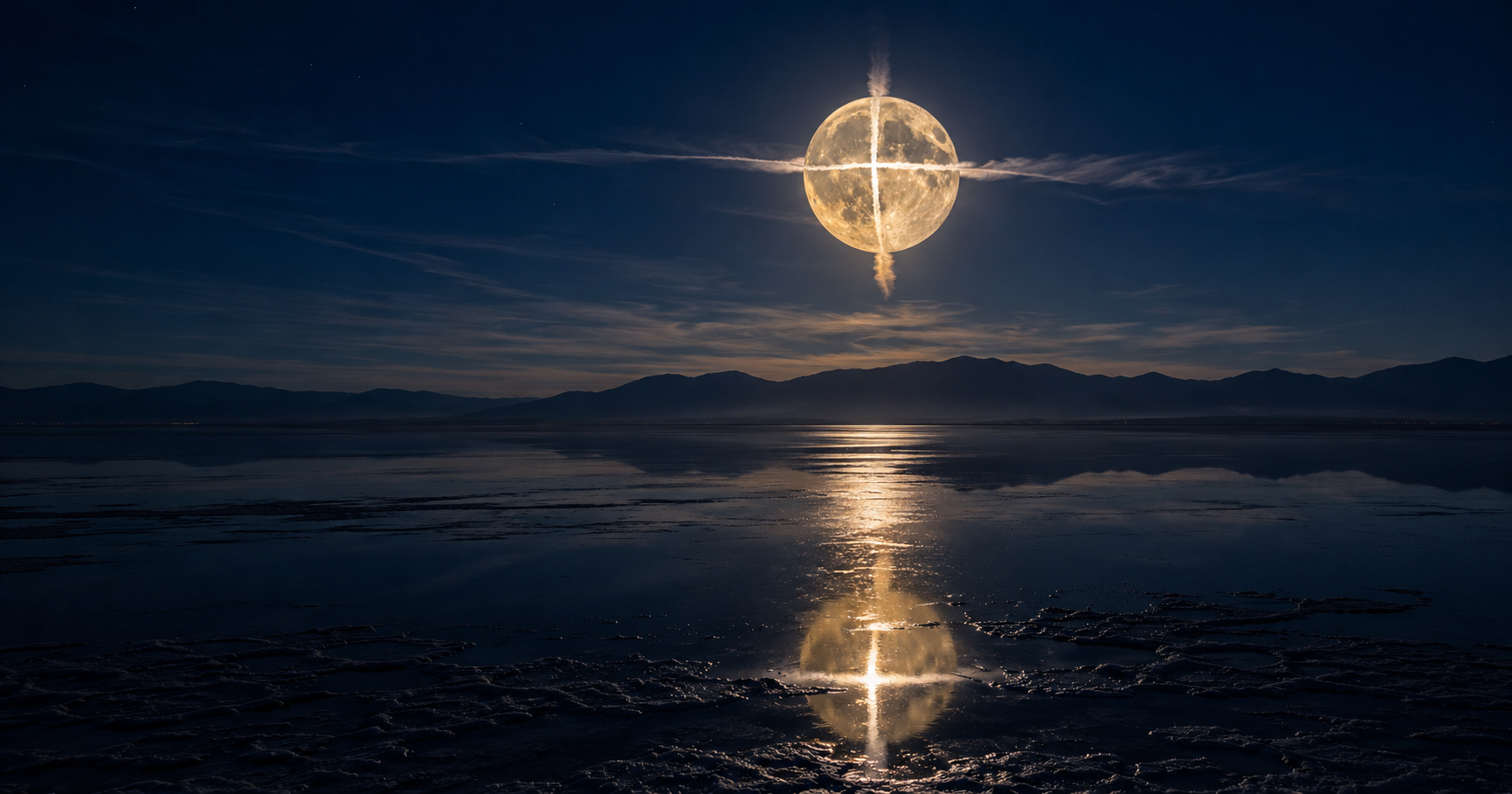
On the night of August 22, 2021, there was a full moon — a rare seasonal Blue Moon, as it happens. And that night, the clouds over that full moon formed a cross. A literal cross of clouds across the face of the moon. The sign the early church fathers had been describing for seventeen centuries — the cross in the heavens, the conspicuous cross among the clouds — and the sign Gayla Wise described, the Shechinah, the presence of the Lord returning in light. Both traditions, one night.
I believe that night marked the establishment of the terrestrial New Jerusalem — the earlier, lower manifestation from Moses 7 — and the beginning of the messianic age. I write about this event in detail in my book, and I'll tell you the same thing here that I say there: I can't hand you a laboratory proof. What I can tell you is what the Lord has shown me, and that this reading is consistent with the sequence scripture actually gives.
So where are we on the timeline? I believe Christ has returned — and is on the earth right now the same way the Father was with him during his mortal ministry. Not yet as a king on a throne in the fullness of celestial glory. As presence. As the Shechinah dwelling in the temple of the body of everyone who enters the kingdom. Enoch and his holy city, the saints Jude says the Lord comes with, ten thousands of them — returned, gathered into the body of Christ, the body of the anointed. We are living in the new heaven and the new earth, in its terrestrial degree.
He came like a thief in the night. And almost nobody noticed. Which is exactly what a thief in the night means.
Binding the Dragon: How the Messianic Age Becomes the Millennium
If Christ has returned, the obvious question is: why doesn't the world look like the millennium yet?
Because the next item in the sequence is ours to do. Revelation 20 describes an angel coming down to bind the dragon, that old serpent, the devil. And in scripture, an angel is a messenger — one who comes bearing a message. Messages don't bind anything by existing. They bind when they are obeyed.
I believe the message is the one this whole post has been building toward: Christ has already returned, and the kingdom of God is open. And here's the mechanics of the binding, as the Lord has shown me. When a person enters the kingdom — when they come into the presence of God dwelling within them — they find a remission of their sins. Christ says this throughout scripture. And a person who has found remission of sins is a person the serpent can no longer tempt. No dominion. No legal claim. Satan becomes bound, person by person, heart by heart, until the dragon has no more dominion on this earth.
That's not a passive timeline where we wait for God to do something to us. It's a harvest. We are in the harvesting season right now, and the work in front of us is bringing as many people as we can into the kingdom. Every person who enters is another link in the chain that binds the dragon. The messianic age has started; the millennium — the actual thousand years of peace — unfolds exactly as fast as we obey the message.
The End of the Timeline: The Celestial New Jerusalem
And then, at the end of the thousand years of growing in the spirit together, comes the city John saw.
The celestial New Jerusalem. The higher manifestation — a higher dimension, honestly, than what we can currently receive. The Lamb of God Himself lighting the city, no sun or moon required. The earth celestialized into a paradise given to everyone who accepted the anointing of God and entered back into His presence. That's when we dwell in the fullness of the glory of God — because a thousand years of peace will have prepared us to actually bear it.
That's the timeline as I read it. Not a date. A sequence — gathering, sign, presence, binding, peace, glory. And a sequence in which you and I are not spectators. We're the harvest workers, and honestly, we're also the harvest.
The question isn't when He's coming. The question is whether we'll enter the kingdom that's already here.
Frequently Asked Questions
What is the sign of the Son of Man in Matthew 24:30?
Scripture never defines it — Matthew 24:30 says the sign will appear in heaven but leaves it undescribed. The two strongest traditions are a cross appearing in the heavens (taught by early church fathers like Cyril of Jerusalem and John Chrysostom) and the Shechinah, the visible glory-presence of God (the reading Gayla Wise argues in The Sign of the Son of Man). I believe both traditions were fulfilled together on the night of August 22, 2021.
Does the Bible say a cross will appear in the sky before Jesus returns?
Not explicitly. The cross-in-heaven expectation comes from early Christian tradition — Cyril of Jerusalem (348 AD), John Chrysostom, Ephrem the Syrian, the Apocalypse of Peter, and the Sibylline Oracles all describe it. It's an interpretation filling the blank Matthew 24:30 leaves open, but it's one of the oldest and most widespread interpretations in Christianity.
What is the Shechinah and what does it have to do with the Second Coming?
Shechinah is a Hebrew word, from the root "to dwell," describing the presence of the Lord in a brilliance of light — the pillar of cloud and fire in Exodus, the glory filling Solomon's temple. Some scholars and authors argue the "sign of the Son of Man" is this same glory-presence returning, which would mean the Second Coming begins as presence rather than as a public physical arrival.
Are there two New Jerusalems in scripture?
Yes, as I read it. Moses 7 in the Pearl of Great Price describes a New Jerusalem established before the millennium — a terrestrial manifestation where the Lord's people are gathered and received into His presence. Revelation 21 describes the celestial New Jerusalem descending at the end of the millennium, lit by the Lamb Himself. Ether 13 also distinguishes the New Jerusalem on this land from the old Jerusalem rebuilt for Israel.
Has Jesus already returned?
I believe He has — in the manner scripture actually describes for this phase of the timeline: as the presence of God, the way the Father's glory dwelt with Jesus during his mortal ministry, marked by the sign on August 22, 2021. The appearance in the fullness of celestial glory comes at the end of the sequence, not the beginning. I hold this as testimony and invite you to test it against the scriptures rather than take my word for it.
How is Satan bound during the millennium?
Revelation 20 says an angel — a messenger with a message — binds the dragon. I believe the binding is legal and personal: when someone enters the kingdom of God and finds a remission of sins, the serpent loses all claim and power to tempt them. As more people obey the message, Satan is bound person by person until he has no dominion left on the earth.
What is the difference between the messianic age and the millennium?
The messianic age is the period we're in now: Christ present on the earth, the kingdom open, the harvest underway. The millennium is the thousand years of peace that fully arrives as the dragon is bound. One has begun; the other unfolds as the message is received.
What does "coming in the glory of the Father" mean?
The Father's glory in Jesus' day was not a separate physical body — it was the indwelling spiritual presence of the Lord. When Jesus promised to return in the glory of the Father, I believe He was describing a return in and as that same presence: the Shechinah, received into the temple of the body, exactly as Moses 7 describes Zion being received into the Lord's bosom.
If this timeline resonates with you — or even if it unsettles you and you want to test it properly — I walk through the whole sequence, including the August 22, 2021 event and the economics of the New Jerusalem, in my book Metanomics: Reverse Engineering the Economy of Zion. The Lord gave me this framework a piece at a time, and sharing it is the whole reason this site exists.
Related: Who Is Metatron? The Complete Scriptural Answer — Enoch's story is the other half of this timeline.